
Key Points
- President Trump signed an executive order to challenge state AI laws.
- The order tasks the DOJ, Commerce Department, FTC, and FCC with reviewing state regulations.
- DOJ must form a task force within 30 days to contest specific state statutes.
- Commerce Department has 90 days to list state AI laws considered burdensome.
- Industry leaders warn the move could spark extensive litigation and increase uncertainty for startups.
- Larger firms are better equipped to handle potential legal battles than smaller innovators.
- Critics argue the order may delay a comprehensive national AI framework.
- Lawmakers express concern over a fragmented regulatory landscape for AI.
Executive Order Overview
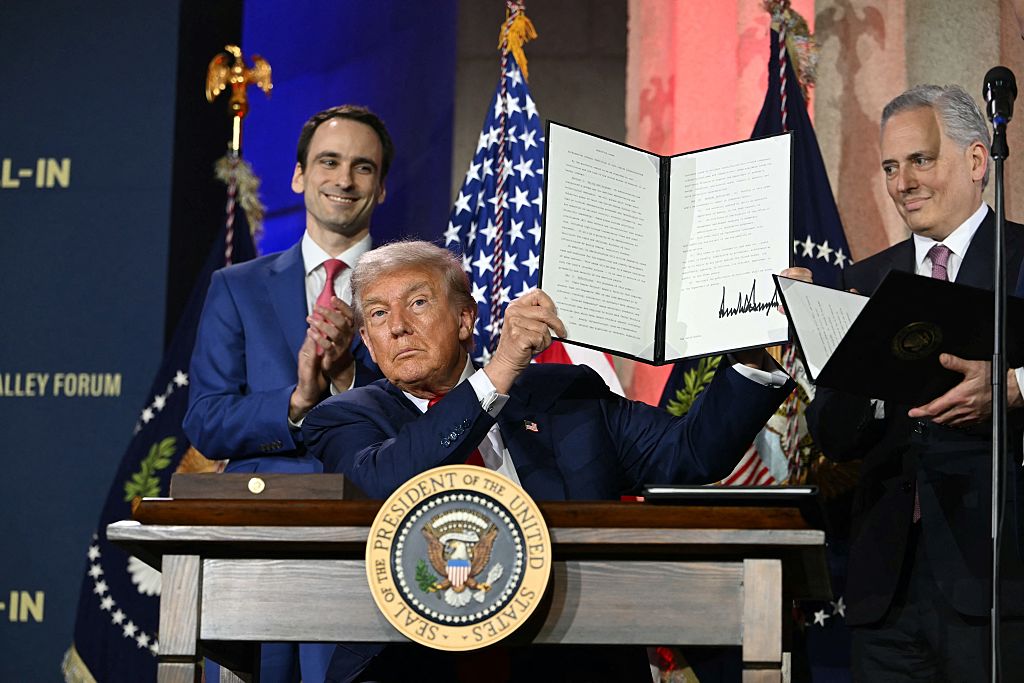
President Donald Trump signed an executive order aimed at challenging state AI laws that he described as an “onerous” patchwork hindering startup growth. The order, titled “Ensuring a National Policy Framework for Artificial Intelligence,” directs several federal agencies to assess and, where possible, preempt state regulations that affect AI development and deployment.
Agency Responsibilities
The Department of Justice is instructed to establish a task force within 30 days to challenge specific state AI statutes on the grounds that AI constitutes interstate commerce and should be regulated at the federal level. The Commerce Department has 90 days to compile a list of state AI laws deemed overly burdensome, a list that could influence states’ eligibility for federal funding, including broadband grants. Meanwhile, the Federal Trade Commission and the Federal Communications Commission are asked to explore federal standards that might preempt state rules.
Industry Reaction
Tech leaders and legal professionals expressed mixed reactions. Some, like Andrew Gamino‑Cheong of Trustible, warned that the order could backfire by creating legal ambiguity that disproportionately harms smaller startups lacking deep pockets for litigation. Others, such as Morgan Reed of The App Association, urged Congress to move quickly toward a comprehensive national AI framework, arguing that the executive order alone cannot resolve the underlying regulatory fragmentation.
Startup founders, including Arul Nigam of Circuit Breaker Labs, highlighted concerns about self‑regulation and the lack of clear standards, noting that uncertainty could slow product development and market adoption. Larger firms, with greater resources, are better positioned to navigate or hedge against the potential legal battles.
Legal and Political Context
The order arrives amid broader debates over whether states should be allowed to enact their own AI regulations in the absence of a federal standard. Lawmakers from both parties have warned that without a unified approach, consumers could face inconsistent protections while companies may encounter a “Wild West” of regulatory environments. Critics of the order argue that it may lead to protracted court battles, potentially reaching the Supreme Court, and could delay the implementation of any cohesive policy.
Outlook
Supporters hope the executive order will pressure Congress to draft a risk‑based national AI framework that balances innovation with consumer protection. Critics, however, caution that the order may extend uncertainty for startups, increase legal costs, and slow the deployment of AI technologies across sectors. The coming weeks are likely to see the Justice Department’s task force evaluate specific state statutes, while industry groups continue to lobby for clear, consistent regulations that support both innovation and public safety.
Source: techcrunch.com