

Key Points
- Apple Music is now a built‑in third‑party app inside ChatGPT.
- Users can request playlists, find songs or albums, and play short clips via chat.
- Apple Music subscribers can link accounts to save generated playlists directly to their libraries.
- Activation is done through the Apps section, the plus sign, or the “@Apple Music” command.
- ChatGPT’s contextual awareness lets music requests be made mid‑conversation.
- Spotify offers a similar ChatGPT app but uses listening history for personalization.
- Apple Music focuses on prompt‑driven playlist creation without leveraging past listening data.
- Sample prompts produce genre‑specific playlists tailored to the request wording.
- The integration highlights AI’s role in simplifying music discovery and management.


Apple Music logo
ChatGPT Apple Music
Apple Music becomes a native ChatGPT app
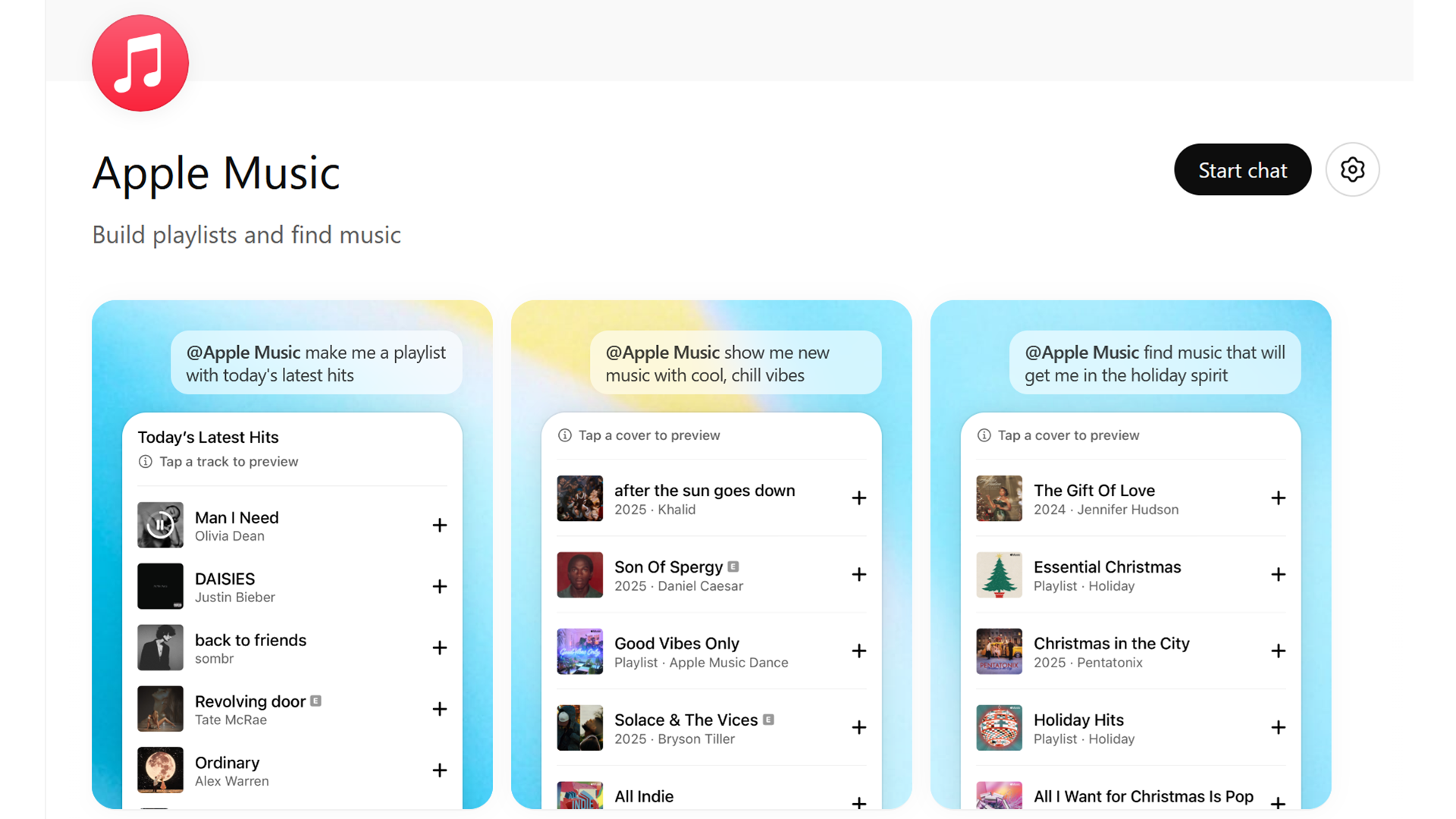
OpenAI has expanded ChatGPT’s ecosystem by adding Apple Music as a built‑in third‑party app. Users can now ask the chatbot to create playlists, locate specific albums or songs, and even play short audio clips of the requested music. When an Apple Music subscriber links their account, the generated playlists can be saved directly to the user’s personal library.
How to activate and use the integration
The setup process is straightforward. Within ChatGPT, users go to the Apps section, search for Apple Music, and connect their account or use the service without an account. Once enabled, the Apple Music app can be invoked by clicking the plus sign in the text bar or by starting a prompt with “@Apple Music.” The chatbot then translates the request into a playable link or a playlist that opens in the Apple Music interface.
Contextual awareness and seamless interaction
One of the notable advantages of the Apple Music integration is its ability to respond to music requests embedded within larger conversations. ChatGPT can quietly open the Apple Music app and suggest relevant tracks or assemble a playlist based on the ongoing dialogue, making the experience feel like a knowledgeable friend who remembers the flow of the conversation.
Comparison with Spotify’s ChatGPT app
Spotify introduced a similar ChatGPT app earlier in the year. Both platforms let users create playlists and retrieve song information via natural‑language prompts. However, Spotify’s version leverages a user’s listening history and preferences to deliver more personalized recommendations. In contrast, Apple Music’s approach builds playlists primarily from the explicit prompts given by the user, without pulling in past listening data.
Both services allow free users and subscribers to connect their accounts and send playlists to the respective streaming platforms. The difference lies in the personalization layer: Spotify’s integration tailors suggestions using prior behavior, while Apple Music focuses on delivering results that match the wording of the request.
Sample prompts and the resulting playlists
Examples of prompts used in testing include “Make a 45‑minute playlist for a fall dinner party in upstate New York,” “Show me music to make my kid laugh,” and “Create a playlist for reading by the fire on a snowy evening.” Spotify’s responses incorporated acoustic folk and moody lo‑fi tracks that aligned with the user’s known tastes, whereas Apple Music offered a more general mix of piano jazz and mellow singer‑songwriter selections, staying true to the literal prompt.
Implications for AI‑driven music discovery
The Apple Music integration demonstrates how AI chatbots can act as a bridge between conversational interfaces and specialized content platforms. By allowing users to request music in natural language and instantly access short clips or full playlists, ChatGPT enhances the discoverability of songs without requiring users to navigate separate apps manually. While Apple has not reinvented music playback, the partnership signals a broader trend of AI assistants incorporating major services to streamline user experiences.
Conclusion
For Apple Music subscribers, the new ChatGPT app offers a convenient way to generate and save playlists without leaving the chat environment. The integration’s strength lies in its prompt‑driven design and contextual responsiveness, providing a user‑friendly alternative to more data‑heavy personalization models like Spotify’s. As AI continues to expand into everyday tasks, the Apple Music‑ChatGPT collaboration illustrates a practical application that could shape future interactions between AI assistants and entertainment services.
Source: techradar.com