
Key Points
- ESA astronomers trained the AI model AnomalyMatch to search Hubble’s archive.
- The system scanned nearly 100 million image cutouts in just two and a half days.
- Nearly 1,400 anomalous objects were identified, many of which are merging galaxies.
- Findings include gravitational lenses, jellyfish‑type galaxies, and objects that defy classification.
- Results were published in Astronomy & Astrophysics and praised as a major AI success.
- The study highlights AI’s role in unlocking new science from existing astronomical data.
AI‑Driven Hunt Through Hubble Data
A team of astronomers at the European Space Agency, David O’Ryan and Pablo Gómez, set out to find hidden treasures in the Hubble Space Telescope’s 35‑year archive. To cope with the sheer volume and noise of the data, they built an AI model named AnomalyMatch. The system was tasked with scanning nearly 100 million image cutouts from the Hubble Legacy Archive, looking for objects that deviated from typical patterns.
The AI approach proved dramatically faster than manual analysis. AnomalyMatch completed the full sweep in just two and a half days, a task that would have taken a large research team many months if done by hand.
Discovery of Anomalous Objects
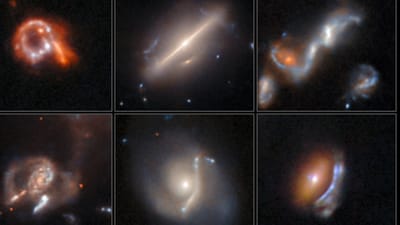
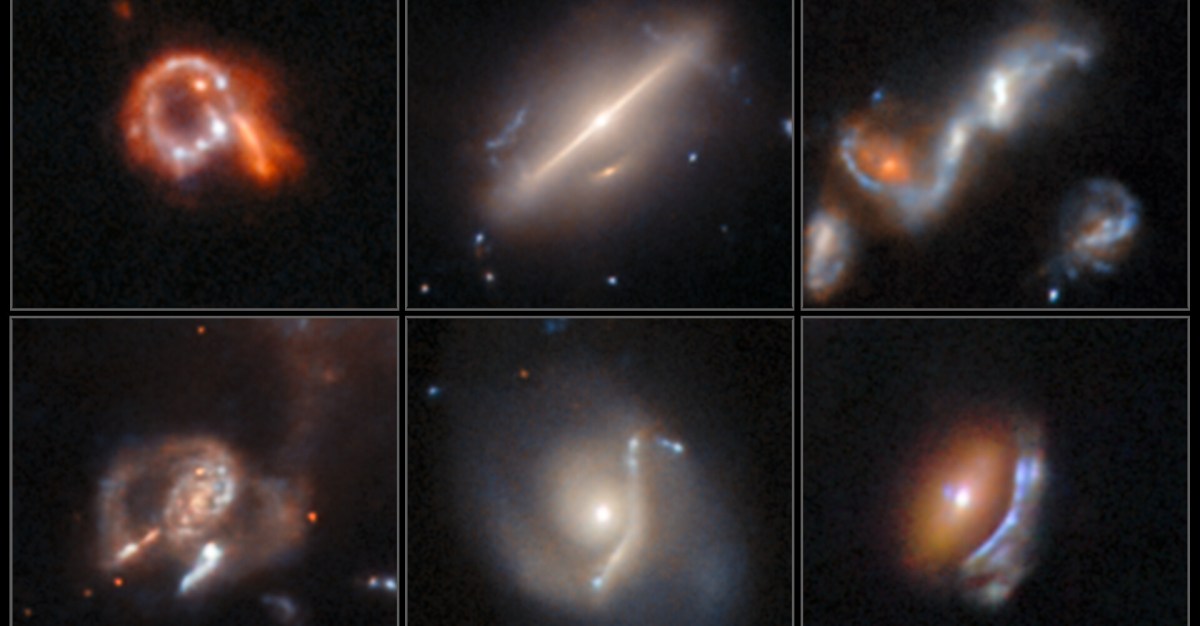
The scan revealed almost 1,400 anomalous objects that had escaped prior detection. The majority were galaxies in the process of merging or interacting, showcasing dramatic gravitational dances. In addition, the AI flagged several gravitational lenses—instances where massive foreground objects bend and magnify light from background sources into arcs or circles.
Other notable finds included jellyfish galaxies, which display trailing “tentacles” of gas, and galaxies with unusually large clumps of stars. Perhaps most intriguing were several dozen objects that defied any existing classification, hinting at phenomena that may broaden current astrophysical understanding.
Scientific Publication and Reactions
The results were published in the journal Astronomy & Astrophysics. In a statement, ESA described the archive as “a treasure trove of data in which astrophysical anomalies might be found.” O’Ryan emphasized the difficulty of studying a universe that is both vast and noisy, noting that AI is especially suited to sift through massive datasets and highlight the oddities that human eyes might miss.
Gómez praised the outcome, calling the discovery of so many anomalies in a well‑studied dataset “a great result.” He added that the success of AnomalyMatch demonstrates how similar tools could be applied to other large astronomical archives, maximizing scientific return from existing observations.
Implications for Future Research
The study showcases how artificial intelligence can accelerate the exploration of legacy data, turning what was once a static archive into a dynamic source of new discoveries. By rapidly identifying unusual objects, researchers can prioritize follow‑up observations and theoretical work, potentially uncovering new physics or refining existing models of galaxy evolution.
Overall, the work underscores a growing synergy between AI technology and astrophysics, suggesting that future telescopes and missions may rely increasingly on automated analysis to keep pace with ever‑expanding data streams.
Source: theverge.com