

Key Points
- DeepMind released Project Genie, an AI tool for creating interactive game worlds.
- The prototype is available to Google AI Ultra subscribers in the United States.
- Users provide text prompts or images to generate explorable environments.
- The system excels at artistic styles but struggles with photorealism.
- Navigation controls can be inconsistent, and characters may pass through walls.
- Safety guardrails block nudity, copyrighted characters, and other restricted content.
- Project Genie is intended as an experimental prototype to collect user feedback.
- The rollout supports broader research into world models for AI and future embodied agents.
Background
DeepMind, the AI research arm of Google, introduced Project Genie as part of its ongoing effort to develop advanced world models—AI systems that can generate internal representations of environments and predict outcomes. The release follows a broader industry push to explore world‑model capabilities for gaming, entertainment, and future embodied‑agent training.
How Project Genie Works
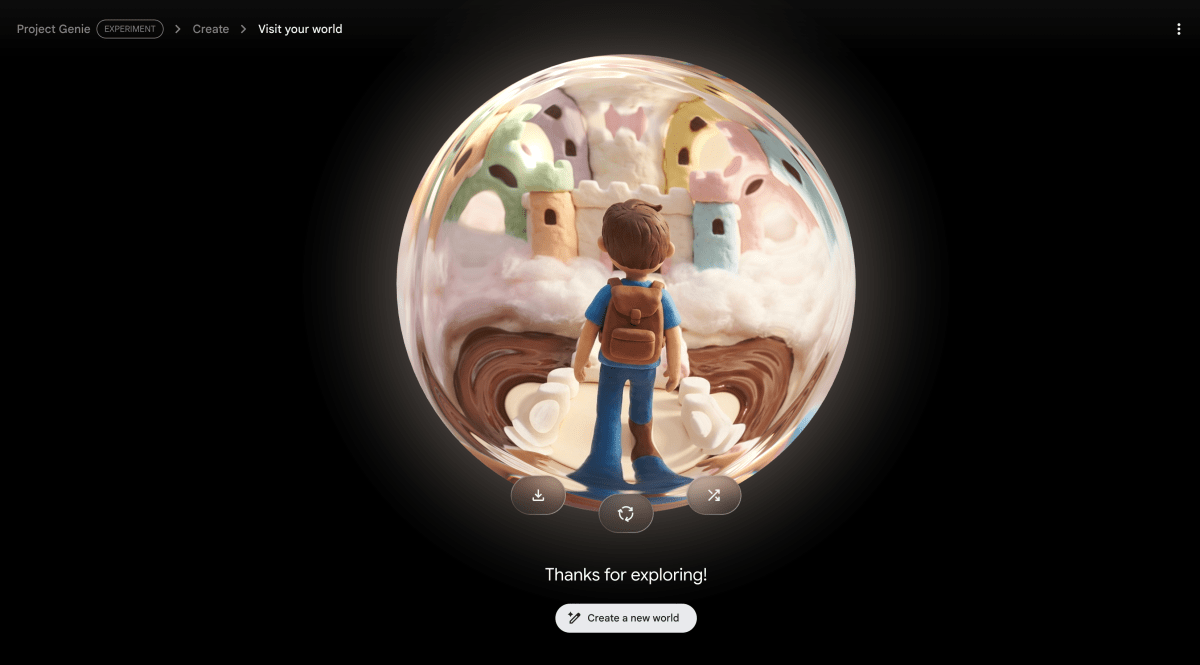
Users begin by providing a “world sketch” through text prompts that describe the setting and a main character. An image‑generation model creates a visual representation based on those prompts, which users can adjust before the world‑model engine builds an interactive environment. The system can also accept real‑world photos as a starting point, though results vary. Once the image is finalized, the model generates a navigable world that can be explored in first‑ or third‑person view. Users can download video captures of their sessions.
User Experience and Limitations
Early testers praised the tool’s ability to render artistic styles such as watercolor, anime, and cartoon aesthetics. However, the model struggled with photorealistic or cinematic scenes, often producing results that resembled video‑game graphics rather than lifelike environments. Navigation controls were reported as occasionally unresponsive, leading to erratic movement. The prototype also imposed safety guardrails that prevented the generation of nudity, copyrighted characters, or other restricted content.
While the system could animate objects and respond to simple interactions, characters sometimes passed through solid surfaces, and the overall dynamism of the environments remained limited. DeepMind acknowledged these shortcomings and emphasized that Project Genie is an experimental prototype intended for feedback collection rather than a polished consumer product.
Implications for AI Development
Project Genie represents a tangible step toward the development of more capable world models, which many researchers view as essential for achieving artificial general intelligence. By opening the tool to a broader audience, DeepMind hopes to gather diverse usage data that can inform future improvements. The initiative also illustrates the growing interest in using AI‑generated worlds for training embodied agents, such as robots, in simulated environments before real‑world deployment.
Overall, the launch of Project Genie highlights both the promise and current challenges of AI‑driven world generation, offering a glimpse of how interactive virtual spaces might evolve as the technology matures.
Source: techcrunch.com