
Key Points
- OpenAI released GPT-5.3-Codex, a new coding model.
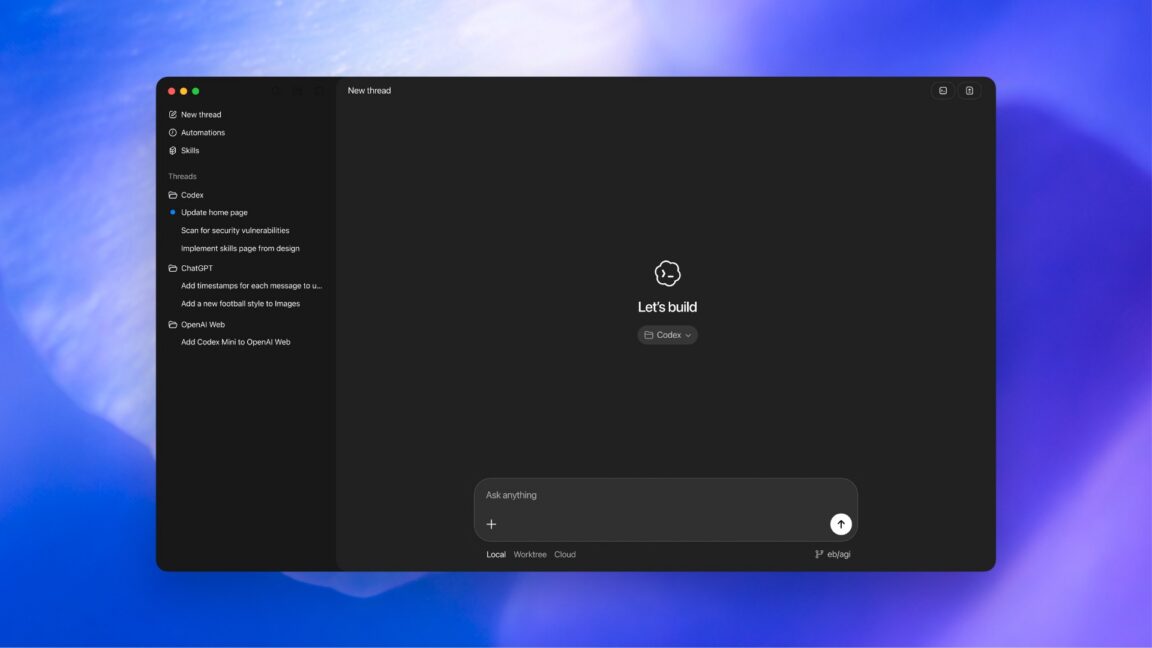
- The model is accessible via command line, IDE extension, web UI, and a macOS desktop app.
- API access is not yet available but is planned.
- Benchmarks show GPT-5.3-Codex outperforms GPT-5.2‑Codex and GPT-5.2 on SWE‑Bench Pro and Terminal‑Bench 2.0.
- OpenAI says the model was instrumental in creating itself, not that it built itself autonomously.
- Designed to support the full software lifecycle, including debugging, deployment, documentation, and metrics.
- Features include mid‑task steering and frequent status updates.
- Future plans include broader API integration.
Announcement and Availability
OpenAI announced GPT-5.3-Codex as the latest iteration of its frontier coding model. The model will be offered via multiple entry points, including a command‑line interface, an integrated development environment (IDE) extension, a web‑based interface, and a new desktop application for macOS. At the time of the announcement, an API for programmatic access was not yet provided, though OpenAI indicated that it is forthcoming.
Performance Benchmarks
According to OpenAI’s internal testing, GPT-5.3-Codex outperforms its immediate predecessor, GPT-5.2-Codex, as well as the earlier GPT-5.2 model on several industry‑relevant benchmarks. Specific improvements were noted on SWE‑Bench Pro and Terminal‑Bench 2.0, among other evaluation suites. These results suggest that the new model delivers higher accuracy and efficiency for coding‑related tasks.
Self‑Creation Claim
OpenAI described GPT-5.3-Codex as “instrumental in creating itself.” While some headlines exaggerated this as the model having built itself, the company clarified that the phrasing refers to the model’s role in its own development process rather than an autonomous self‑construction. The claim underscores the model’s capacity to assist in its own refinement and iteration.
Intended Use Cases
The company positioned GPT-5.3-Codex as more than a code‑generation tool. It is marketed as a comprehensive assistant for the entire software lifecycle, covering activities such as managing deployments, debugging, handling test results, writing product requirement documents, editing copy, conducting user research, and tracking metrics. OpenAI highlighted features that allow users to steer the model mid‑task and receive frequent status updates, aiming to make the interaction more controllable and transparent.
Future Directions
OpenAI indicated that an API will become available in the future, expanding the model’s integration possibilities for developers and enterprises. By offering the model across diverse interfaces and emphasizing its broader utility, OpenAI seeks to position GPT-5.3-Codex as a versatile tool for both individual developers and larger software development organizations.
Source: arstechnica.com