

Key Points
- Claude AI extension now available for Chrome to Pro, Team, and Enterprise subscribers.
- Extension can schedule meetings, organize Google Drive files, and automate multi‑tab tasks.
- Workflow recording lets users teach Claude to repeat custom sequences of actions.
- Broad permissions give Claude deep access to browsing data, raising privacy concerns.
- Anthropic advises against using automated Claude for sensitive activities like banking.
- Compared to other AI extensions, Claude offers deeper web interaction beyond text summarization.

Let Claude handle work in your browser – YouTube
Extension Overview
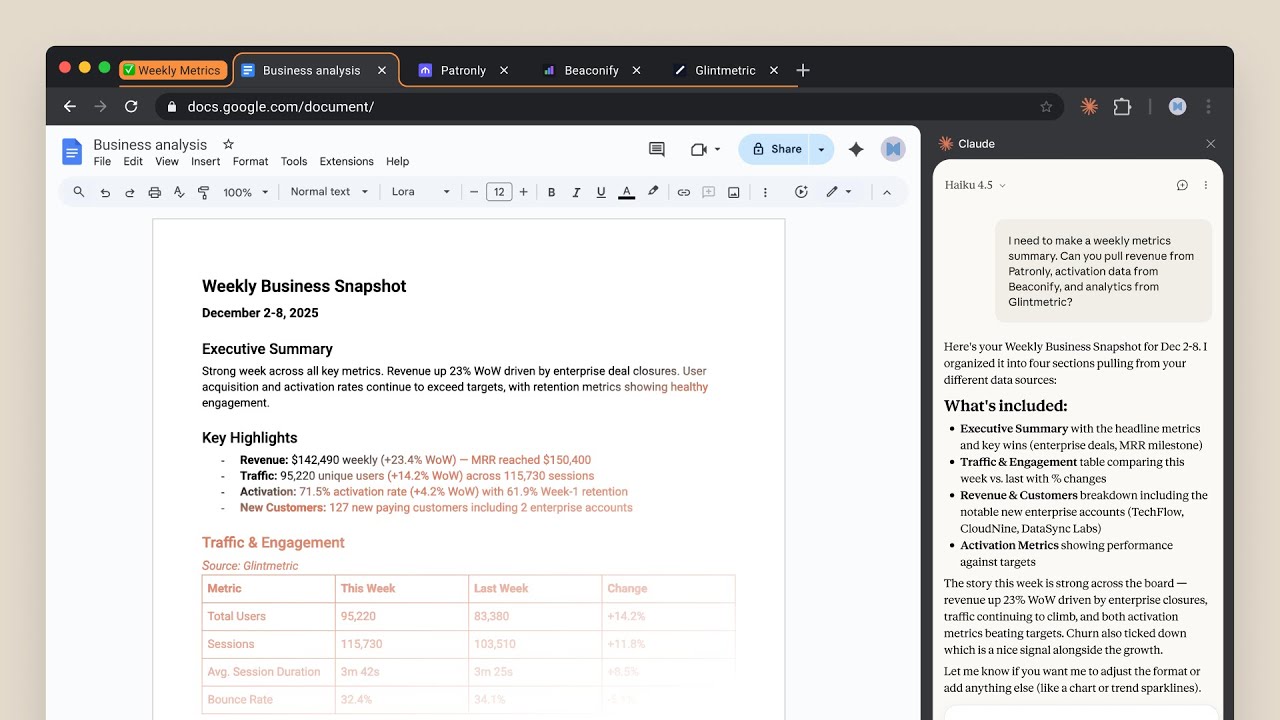
Anthropic has released a Chrome browser extension for its Claude AI assistant, extending access to Claude Pro, Team, and Enterprise subscribers after a period of testing with Max‑tier users. Once installed and authorized, a small Claude icon appears next to the address bar, opening a familiar chat interface that can read and act upon the content of any open webpage.
Key Capabilities
The extension enables a range of tasks beyond simple text summarization. Users can ask Claude to schedule meetings by providing details such as time, location, and participants; the AI then scans the user’s Google Calendar and drafts an email with suggested time slots. Claude can also reorganize a cluttered Google Drive, moving hundreds of documents and spreadsheets into logical folders and removing duplicates, turning a chaotic collection into a structured hierarchy.
Workflow Recording
One of the most distinctive features is the ability to record a workflow. By clicking a record button, users perform a series of actions—opening tabs, filling forms, navigating menus—while Claude observes. When recording stops, Claude captures the sequence as a repeatable task. In practice, a user recorded a series of checks across multiple reward programs and had Claude automatically execute the same steps later, even handling password entry with minor errors. Claude can also propose to run such workflows on a regular schedule.
Privacy and Security Considerations
Granting Claude broad permissions raises privacy concerns. The AI gains access to browsing activity, passwords, and personal files, which some users find unsettling. Anthropic emphasizes that automated Claude should not be used for high‑risk activities like banking. The extension asks for explicit permissions when a workflow involves sensitive data, but the depth of integration means users must remain vigilant about what information they expose.
Comparison with Other AI Extensions
Unlike many AI browser extensions that limit themselves to summarizing selected text, Claude’s deep‑dive capabilities allow it to act as a representative within the web environment. This includes interacting with multiple tabs, performing actions on behalf of the user, and learning complex task sequences. While this makes Claude more powerful, it also intensifies the trade‑off between convenience and data exposure.
Outlook
Claude in Chrome showcases how AI agents can move from passive assistants to active participants in daily online workflows. As the technology matures, balancing functionality with robust privacy safeguards will be critical to broader adoption.
Source: techradar.com