

Key Points
- Anthropic, OpenAI, Block and others form the Agentic AI Foundation with the Linux Foundation.
- The foundation focuses on the Model Context Protocol (MCP) as a standard for AI‑agent data access.
- MCP is likened to a “USB‑C port for AI,” enabling uniform connections to databases and cloud services.
- Google and OpenAI have already added MCP support to their development tools and products.
- MCP simplifies integration, reduces custom‑connector work, and extends capabilities of local AI models.
- Early adopters like the Pebble Index 01 ring showcase MCP‑enabled personalization on edge devices.
- A shared protocol may lower entry barriers, boost competition on features, and foster ecosystem collaboration.

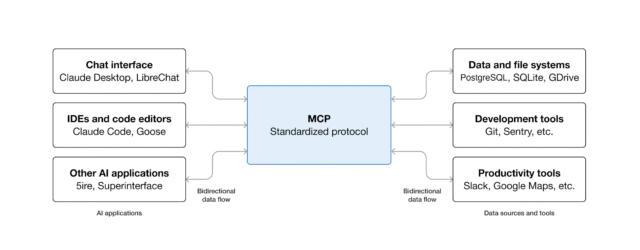
mcp simple diagram
Collaboration Overview
In a coordinated effort to bring order to the rapidly evolving field of agentic artificial intelligence, several leading technology firms have aligned with the Linux Foundation to form the Agentic AI Foundation (AAIF). The coalition includes Anthropic, OpenAI, Block and other prominent players who share a common interest in establishing interoperable standards for AI agents.
The centerpiece of the AAIF’s initial work is the Model Context Protocol (MCP), an open‑source specification originally released by Anthropic. MCP is described by its creators as a “USB‑C port for AI,” providing a uniform way for AI agents to connect to a wide variety of data sources—whether databases, cloud storage platforms, or other services—without requiring custom integrations for each destination.
Since its release, MCP has already seen adoption by major industry participants. Google incorporated MCP support into its development tools at its recent I/O event, and OpenAI followed suit a few months later, adding MCP compatibility to its own suite of products. These early adopters illustrate the growing momentum behind a shared protocol that could become a de‑facto standard for AI‑driven applications.
Implications for AI Development
The establishment of a common protocol promises several tangible benefits for developers and end users. By standardizing how agents access external data, MCP reduces the engineering overhead associated with building bespoke connectors, allowing teams to focus on higher‑level functionality and user experience.
Local AI models, which often lack the breadth of cloud‑based services, can leverage MCP to “handshake” with multiple cloud providers for complex tasks, effectively extending their capabilities while preserving on‑device processing where desired. This hybrid approach is highlighted by examples such as the Pebble Index 01 ring, which uses a local language model that supports MCP for voice‑note handling and personalization.
Beyond technical efficiencies, the AAIF’s work may shape the broader market dynamics of AI agents. A unified standard can lower barriers to entry for new developers, encourage competition based on innovative features rather than proprietary integrations, and foster a more collaborative ecosystem. As more companies adopt MCP, the protocol could serve as a lingua franca for AI agents, enabling seamless interaction across platforms and services.
Overall, the partnership between big‑tech firms and the Linux Foundation represents a strategic move to bring cohesion to an otherwise fragmented AI landscape. By championing open standards like MCP, the AAIF aims to accelerate the practical deployment of agentic AI, turning theoretical concepts into everyday tools that enhance productivity, creativity, and user empowerment.
Source: arstechnica.com