
Key Points
- OpenAI launches “Your Year with ChatGPT,” a year‑end recap modeled after Spotify Wrapped.
- The feature offers personalized awards, custom poems, and pixel‑art based on 2025 chats.
- Users can access the recap via a homepage button or by typing “/Your Year with ChatGPT”.
- Personality archetypes such as Creative Debugger, Visionary Voyager, and Navigator are assigned.
- Statistical highlights include placement among the first 0.7 % of users and over 8,000 messages sent in a year.
- Typical activities shown include summarizing meetings, explaining legal decisions, and acting as a dungeon master.
- OpenAI stresses that the tool is opt‑in and does not use deleted chats.
- The recap is currently available in the U.S., U.K., Canada, Australia, and New Zealand.
- The feature aims to shift ChatGPT toward a more companion‑like experience.


Year with ChatGPT

Year with ChatGPT Archetype
Introducing a Year‑End Recap for ChatGPT Users
OpenAI has launched a new feature titled “Your Year with ChatGPT,” designed to give users a reflective look at how they have interacted with the AI over the past year. The concept draws clear inspiration from the annual Spotify Wrapped experience, offering a personalized summary of chat activity, usage patterns, and creative highlights.
How the Recap Works
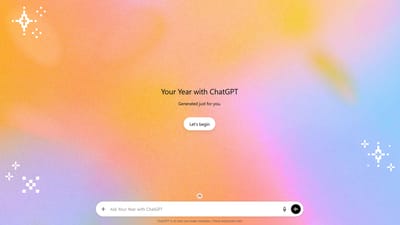
The recap visualizes a user’s chat history, presenting statistics and illustrations that blend humor with data. Users can find a dedicated button on the ChatGPT homepage or simply type the command “/Your Year with ChatGPT” to access the feature. Once activated, the tool generates a dashboard that includes personalized awards, custom poems, and pixel‑art graphics derived from the user’s 2025 conversations.
Personalized Elements and Personality Archetypes
Among the standout elements are custom awards that recognize specific interaction patterns and a set of personality archetypes that categorize users based on their chat behavior. Examples of archetypes include Creative Debugger, Visionary Voyager, and Navigator. The recap also assigns users to percentile groups, noting, for instance, placement among the first 0.7 % of ChatGPT users and highlighting high‑volume activity such as sending more than 8,000 messages in a year.
Interactive and Creative Highlights
The recap showcases a range of typical user activities, from summarizing meeting transcripts and explaining Supreme Court decisions to acting as an imaginary dungeon master. Stylized characters and illustrative graphics depict these diverse use cases, adding an emotional and visual dimension to the statistical overview.
Privacy and Opt‑In Design
OpenAI emphasizes that “Your Year with ChatGPT” is an opt‑in feature that respects user privacy. The documentation specifies that the recap does not incorporate deleted chats, ensuring that only retained conversation data contributes to the summary. This approach contrasts with more opaque data‑driven experiences elsewhere, reinforcing OpenAI’s commitment to transparent user controls.
Positioning the Recap as a Companion Experience
Beyond the metrics, the feature hints at a broader strategic direction for OpenAI. By framing the recap as a reflective, personality‑mapping tool rather than a purely functional report, the company signals an intent to position ChatGPT as a companion in users’ daily lives. The inclusion of personalized poems, awards, and archetype classifications suggests a shift toward deeper engagement, inviting users to see their interactions as part of a larger narrative.
Availability and Market Reach
The year‑end recap is currently available to eligible users in the United States, United Kingdom, Canada, Australia, and New Zealand. This rollout aligns with OpenAI’s broader efforts to expand feature accessibility across key English‑speaking markets.
Conclusion
“Your Year with ChatGPT” adds a creative, data‑driven layer to the user experience, blending personalization, visual storytelling, and privacy‑focused design. As users explore their chat histories through this new lens, OpenAI continues to evolve the role of its AI from a tool toward a more companion‑like presence in everyday digital interactions.
Source: techradar.com