

Key Points
- OpenAI introduced app‑suggestion pop‑ups for paid ChatGPT users, then removed them after backlash.
- Chief Research Officer Mark Chen apologized, saying the feature felt like an ad and was mishandled.
- Rumors claimed Google’s Gemini AI would add ads, but Google denied any current plans.
- Google emphasized Gemini remains ad‑free and focused on user experience.
- High compute costs could push AI platforms toward advertising revenue models.
- AI assistants are becoming central hubs for search, recommendations, and app discovery, areas where ads thrive.
- Gemini currently differentiates itself by offering a clean, interruption‑free interface.
Gemini on a smartphone.
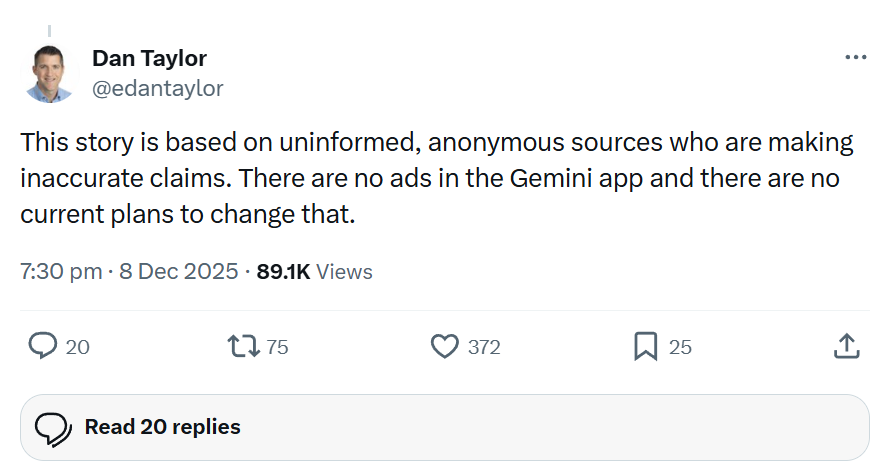
Dan Taylor Tweet on X
OpenAI’s brief foray into ad‑like suggestions
Subscribers to the $200‑a‑month tier of ChatGPT began seeing “app suggestions” embedded in their conversations. The pop‑ups resembled advertisements and quickly drew criticism from users. OpenAI responded by disabling the feature and Chief Research Officer Mark Chen issued an apology, stating, “anything that feels like an ad needs to be handled with care, and we fell short.”
Google’s Gemini and the ad rumor
At the same time, speculation spread that Google’s Gemini chatbot would soon incorporate ads. Google directly refuted the claim, asserting, “There are no ads in the Gemini app, and there are no current plans to change that.” The company emphasized that Gemini remains free of advertising interruptions.
Why ads may become inevitable
Industry observers point out that the massive compute expenses behind large‑scale AI models create a financial pressure that could eventually drive platforms to explore advertising revenue. As AI assistants evolve into primary venues for search, recommendations, and app discovery, the environment becomes attractive for ad placement.
Gemini’s current stance
Despite the broader industry trend, Gemini currently offers a user‑friendly, ad‑free experience. Its design focuses on delivering clean, uninterrupted interactions, distinguishing it from competitors experimenting with monetization through ads.
Looking ahead
The debate continues over whether AI chatbots will eventually adopt ad‑based models. OpenAI’s recent misstep highlights the sensitivity of users to any perceived commercial content, while Google’s firm denial suggests a strategic choice to maintain an ad‑free interface for now. The future may see these platforms revisit the balance between revenue needs and user experience as the AI market matures.
Source: techradar.com