

Key Points
- Harness raises $240 million in a Series E round led by Goldman Sachs.
- Post‑money valuation climbs to $5.5 billion, up from $3.7 billion.
- Funding will expand R&D, hire hundreds of engineers in Bengaluru, and boost global go‑to‑market efforts.
- AI agents powered by a knowledge graph automate testing, security and deployment—the “after‑code” phase.
- More than 1,000 enterprise customers, including United Airlines and National Australia Bank, use Harness.
- Platform has processed 128 million deployments, 81 million builds and protected 1.2 trillion API calls.
- Company employs over 1,200 staff, with roughly one‑third based in India.
- Recent merger with Traceable enhances DevOps and application‑security capabilities.
- Founder Jyoti Bansal signals a future IPO but has not set a timeline.

Funding and Valuation
Harness, the San Francisco‑based AI DevOps firm founded in 2017 by Jyoti Bansal, disclosed a fresh $240 million Series E financing round. The round values the company at $5.5 billion post‑money, representing a sizable increase from its prior $3.7 billion valuation. Goldman Sachs led the primary $200 million investment, while a $40 million tender offer was co‑led by IVP, Menlo Ventures and Unusual Ventures to give long‑term employees liquidity.
Strategic Use of Capital
The new funds are earmarked for a multi‑pronged growth strategy. Harness plans to expand its research and development capabilities, hiring “hundreds of engineers” at its Bengaluru development center, which already accounts for roughly a third of its 1,200‑person workforce. The company also intends to broaden its U.S. go‑to‑market operations and accelerate its presence in international markets.
Addressing the “After‑Code” Gap
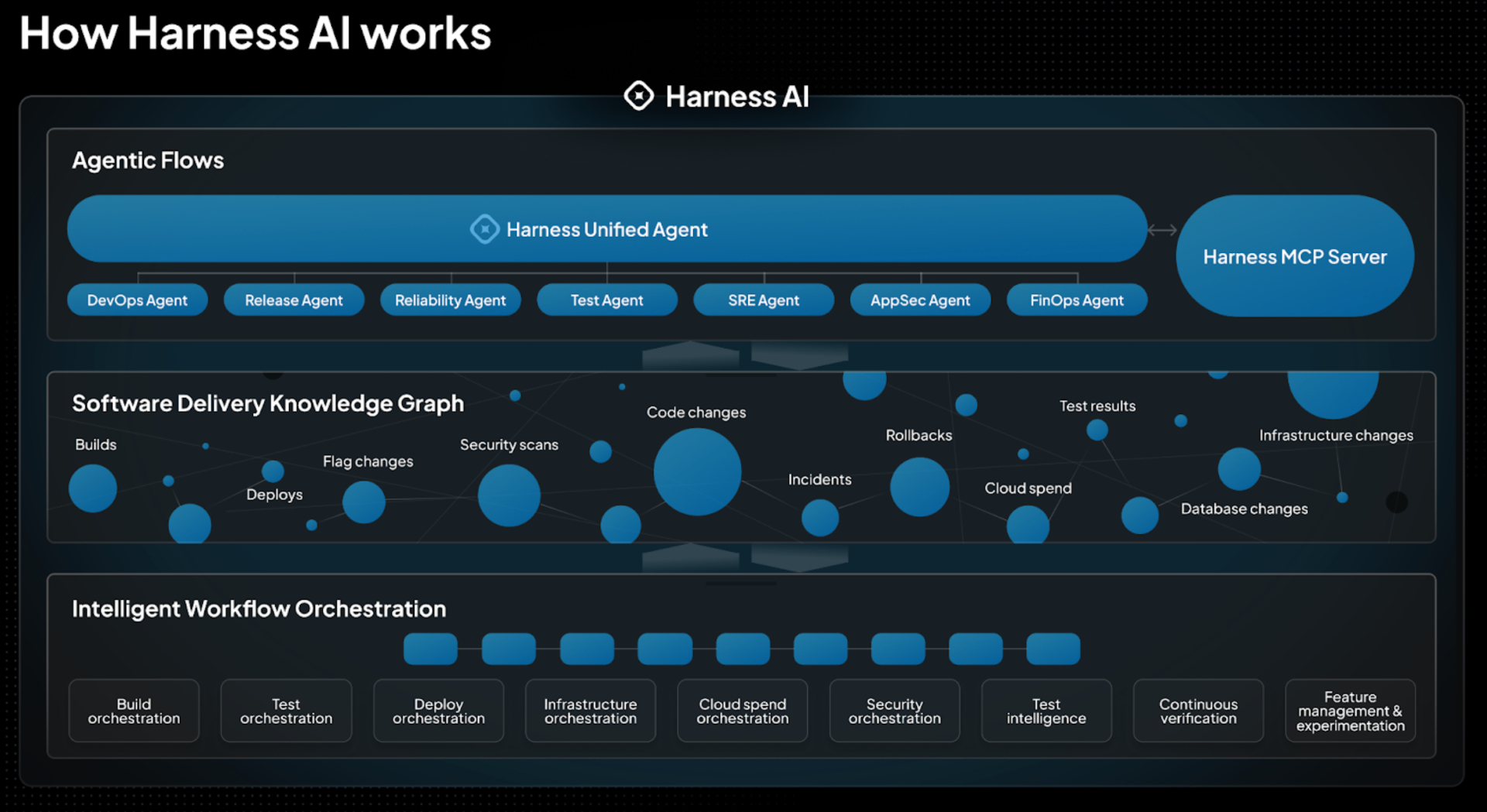
As AI accelerates code generation, the software industry faces a bottleneck in the post‑coding phase—testing, security checks, and deployment—that consumes nearly 70% of engineering time. Harness’s platform uses AI agents built on a software‑delivery knowledge graph to automate these tasks. The graph maps code changes, services, deployments, tests, environments, incidents, policies and costs, providing context that enables AI‑driven pipeline generation, verification, security and governance.
Product Differentiation and Market Traction
Unlike generic AI platforms, Harness’s knowledge‑graph approach delivers deep, customer‑specific insight into software delivery processes. The system still incorporates human oversight, with engineers, compliance teams or auditors reviewing AI‑generated tests or fixes before production. Competitors include Microsoft’s GitHub, GitLab, Jenkins and CloudBees.
Harness now serves over 1,000 enterprise customers, including United Airlines, Morningstar, Keller Williams and National Australia Bank. The platform has processed 128 million deployments, 81 million builds and protected 1.2 trillion API calls, helping customers optimize roughly $1.9 billion in cloud spending in the past year.
Organizational Growth and Future Plans
The company employs more than 1,200 people across 14 offices worldwide, with a significant engineering presence in Bengaluru and a corporate office in Gurugram. The Bengaluru site is the largest development center outside the United States. Earlier this year, Harness merged its software observability firm Traceable into the business, strengthening its DevOps and application‑security portfolio.
Looking ahead, Bansal indicated that Harness remains focused on eventually going public, though no specific timeline was disclosed. The company’s leadership described the business as “very healthy, very strong, high growth and margins,” positioning it for a potential IPO when market conditions are favorable.
Source: techcrunch.com